How to Choose an AI Comic Generator When the Comic Is a Gift
Making a comic for yourself and making one as a gift are different problems. Likeness, print and lead time start to matter more than how fun the tool is, and sometimes a different gift altogether is the better idea.
Last reviewed . Written by our editorial team from our own product knowledge and publicly available information on other tools and gift formats. We make myComics, which comes up here next to the alternatives; the opinions are ours.
By the myComics.ai Editorial Team8 min read
Gift guide · 2026 guide · Editorial disclosure
Quick answer
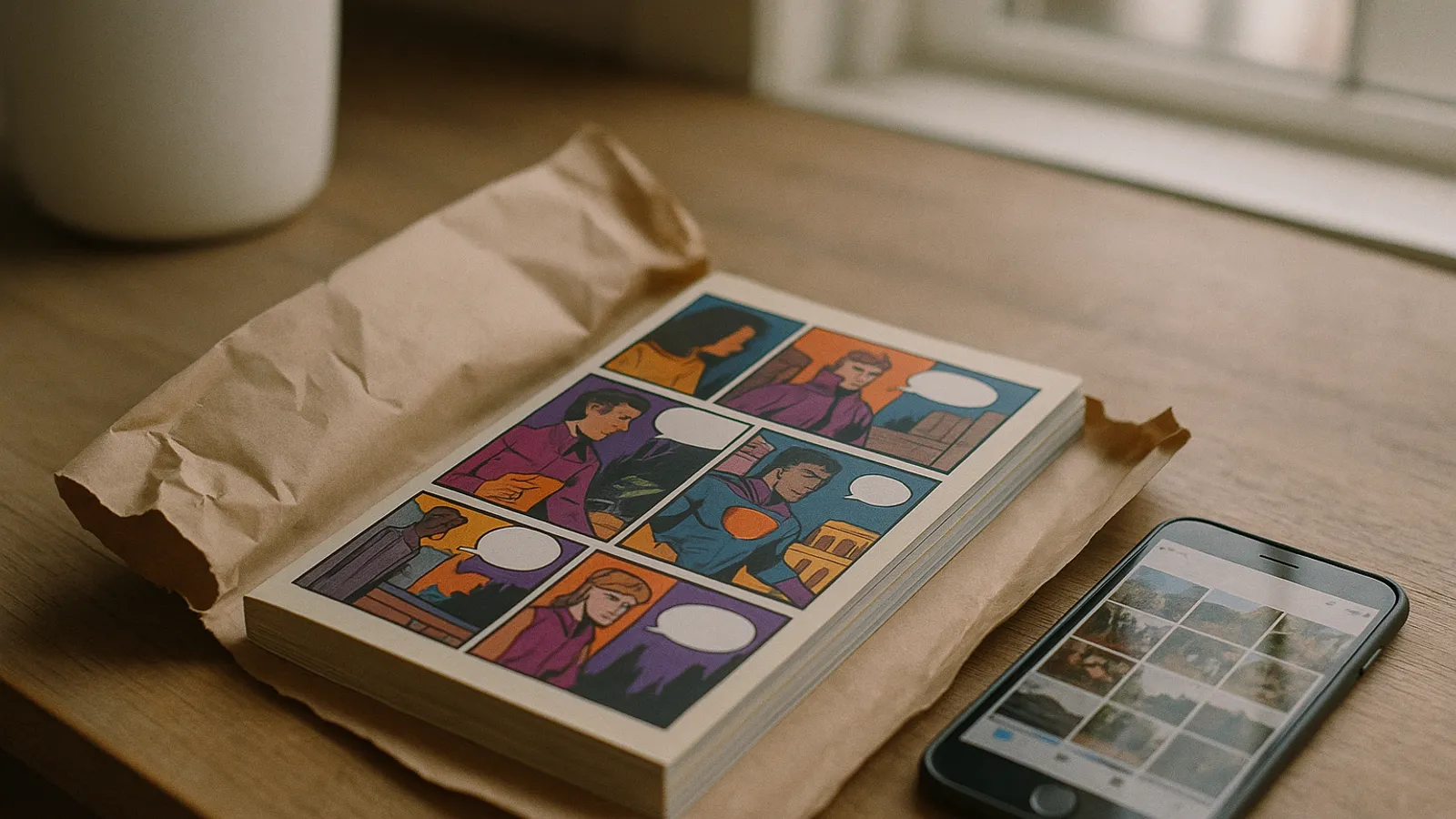
- For a gift, the things that decide the outcome are likeness across panels, what you hand over at the end, and lead time. The number of styles a tool advertises rarely matters.
- Likeness matters most because the recipient knows that face better than anyone. If it drifts between panels, they will notice.
- Work backwards from the date. Printing and shipping, not generation, are what usually make people miss a deadline.
- A personalized comic is not always the right gift. A photo book, a commissioned illustration or a handwritten letter can be the better choice, and we try to say when.
Picture your sister opening a comic about herself at her fortieth birthday dinner. The first thing she looks at is not the story or the colors. It is her own face, and whether it is really her. Everyone at the table will lean over and do the same. That small moment is why making a comic as a gift is a different problem from making one for yourself, and why the usual feature comparisons miss the point.
A quick note before we start: we make myComics.ai, one of the tools you might consider for this. We have tried to write the guide so it is useful even if you end up choosing a different tool, or a different gift entirely.
Why does character consistency matter more than anything else?
Every AI comic tool can show you a lovely single panel. That is the easy part. The hard part is panel eleven.
A gift comic gets read closely, slowly and more than once, by someone who has known that face their whole life. If the jawline changes between pages, or wavy hair turns straight, or the glasses quietly disappear halfway through, they will see it. Not because they are looking for flaws, but because recognizing faces is one of the few visual tasks people are very good at.
This is the distinction worth understanding when you compare tools. Some tools transform one picture at a time, like a filter. Others build a reusable character from several photos and redraw that character in new poses and angles on every page, which is the approach myComics takes. The sample images can look similar. What happens across a whole book usually does not.
What should you check before committing to a tool?
Four things, roughly in the order they tend to cause trouble.
Does it hold a face across panels? Covered above. Try it rather than reading about it.
Can you see the character before the pages exist? A tool that shows you the character first lets you fix a weak likeness early, by swapping photos. A tool that only shows finished pages makes you find out after the fact, when the options are starting over or living with it.
What comes out at the end? A link, a PDF and a printed book are three different gifts. Know which one you are giving before you start, because it changes how much care the photo step deserves. Print is less forgiving than a phone screen.
How long does the physical part take? This is the one that ruins deadlines, and it is worth checking with whoever does the printing rather than assuming.
A fifth point is worth a sentence even though it rarely decides anything: how many people can appear in the same story. Most gift comics have one subject, but plenty have two, such as a couple, a parent and child, or two friends with a long shared history. If yours does, check that each person gets their own character built from their own photos rather than being approximated from one group shot, because the second face is often the one that comes out wrong.
Which output do you actually want?
Worth deciding at the start rather than discovering at the end.
| Output | Good for | What it asks of you |
|---|---|---|
| Read online | Spontaneous, long distance, low stakes | Very little, a rough likeness is fine |
| Keepsakes, printing a page or two yourself | Decent photos, since it gets reread | |
| Printed book | Milestones, gifts given in person | Good photos and a real lead time |
The printed book is the version most people picture when they imagine giving a comic, and it is also the one with a deadline attached. If that is what you want, treat the personalized comic book as the plan and everything before it as a preview.
Is a personalized comic the right gift at all?
Worth asking before you spend an evening on it, because it is a specific kind of present and it does not suit everyone.
It works when the relationship has a story in it. A shared trip, a running joke, the year someone changed careers, the way two people met. The comic tells that story back to the person, and it does something a framed photo cannot: it puts them inside a narrative rather than just showing them.
It works less well as a generic gesture. A comic about someone you do not know well tends to be about nothing in particular, and the personalization becomes decoration, their face in a story that could have starred anyone. If you cannot name the premise in one sentence, take that as a signal.
It also depends on the recipient. Some people love being made the hero of something; others find being the center of attention a little uncomfortable. You probably already know which one you are buying for.
And there is a practical filter: you need photos. Three to eight usable pictures with the face clearly visible. For a partner or a close friend that is easy. For a colleague or an in law you see twice a year, it may be the quiet reason to choose something else.
What are the good alternatives to a comic?
In our view, these are the honest options, and each one is the better pick in some situations.
A photo book. If the point is the memories themselves, real photos in order are hard to beat. They need no story, no premise and no style decision, and older relatives in particular often prefer them. If you find yourself choosing comic panels mainly to show off real moments, a photo book may simply be the better gift.
A commissioned illustration or comic from a human artist. For a once in a lifetime occasion, with a comfortable budget and plenty of lead time, an illustrator brings judgment and personality that no tool does. You give up control over the story and some speed; you gain someone else’s eye. We would suggest this for a wedding or a big anniversary if the timing allows.
A single portrait or caricature. If you like the idea of seeing someone drawn but do not have a story to tell, one good portrait is simpler and often lands just as well.
A letter or a small book of memories you write yourself. Unglamorous and very effective. For some people, a handwritten page means more than anything designed.
A comic you draw yourself. Stick figures included. It will not look professional, and the recipient will not care. If you enjoy drawing even a little, this can be the most personal choice on the list.
A photo built comic sits between these: more narrative than a photo book, faster and more hands on than a commission, more polished than stick figures. If that middle ground is what you want, keep reading. If one of the options above made you nod, go with it.
Does style choice matter for a gift?
Less than you would think, and in a different way than you would think.
The instinct is to pick the style you like. For a gift, pick the one that fits the story you are telling about the recipient. Superhero reads as celebration, so it suits a graduation, a promotion, a marathon finish. Manga carries sincerity and comedy equally well, which makes it good for friendships and long histories. Noir is funny when the subject is deadpan and cold when they are not. Cartoon is the safe choice for kids and pets, and reads as affectionate rather than grand.
The mistake is picking a style that flatters your taste but misreads the relationship: a noir comic for someone earnest, a cartoon for someone who wanted to be taken seriously. Say the premise out loud, then ask which style you would expect to see it drawn in. That instinct is usually more reliable than browsing samples.
What do people get wrong about timing?
They budget time for the wrong step.
Generating the comic is quick, an unhurried evening. What people underestimate is everything after: reading it through properly, noticing something they want to change, regenerating, and then printing and shipping. Each of those is small. Together, on a week’s notice, they are the difference between a gift and an apology.
The practical rule: pick your date, subtract shipping, subtract a buffer for one reprint, and start before that. If the answer is that you do not have that much time, give the digital version on the day and the printed one later. In our experience writing about gifts, that tends to go over better than a rushed print.
How should you compare tools without wasting a week?
Do not rely on comparison tables, ours included. Every tool’s own examples are its best output, chosen by people who know which prompts flatter it.
Instead, run the same short check on each candidate: take your real source photos, the ones you would actually use rather than idealized studio shots, build one character, and look at it. That single step exercises the part that decides everything after it, and it tells you more than a marketing page can.
If you want a shortlist rather than a blank page, our ranking of the best AI comic generators goes through nine tools and what each is built for, and there is a separate look at what the free tiers can and cannot do. Use them to decide what to try, not to pick a winner. Our own best AI comic generator page covers how myComics approaches the same criteria, with the caveat that we wrote it.
What if the likeness is not quite right?
More often than not, the photos are the problem rather than the tool.
The usual culprits: a single source photo instead of several, harsh side lighting, a heavy beauty filter that already changed the face, or a group shot where your subject is one face among many. Swapping in three or four better pictures tends to fix more likeness complaints than switching products does. It is also worth remembering that any AI comic gives a stylized likeness, closer to a caricature than a photograph, so expect “clearly her” rather than a perfect copy.
If you have not been careful with the photo step, that is the easiest thing to fix first. There is a full walkthrough in how to turn your photos into a comic.
So what should you do first?
Decide whether a comic is the right gift, or whether a photo book, an illustrator or a letter fits the person better. If it is a comic, pick your output, work backwards from the date, then spend a few minutes choosing photos properly and build one character. You will have a good sense of whether it works from your own photos, which is a better basis for the decision than anyone’s marketing page, ours included.